
Paracord 550 can support more than you might expect, but it is still not a climbing rope. This article clearly explains what customers often search for as “paracord load capacity”, why tensile strength is the more accurate term, how safe working load relates to it and why Paracord 550 is commonly used in completely different ways from certified ropes.
Imagine that you are setting off on a trip, going camping or heading into the woods. You have a bundle of paracord in your backpack. This “ordinary cord” can do more than it might appear at first glance. It can secure equipment, help with repairs and be used to tie down a tarp, make a dog leash, collar or bracelet, or secure items together in an emergency.
The type most commonly used in our range is Paracord 550 Type III. We will therefore use it to explain what tensile strength means, why a value of approximately 250 kg (550 lb) is not the same as a normal safe working load and why a safety margin is essential in practice.
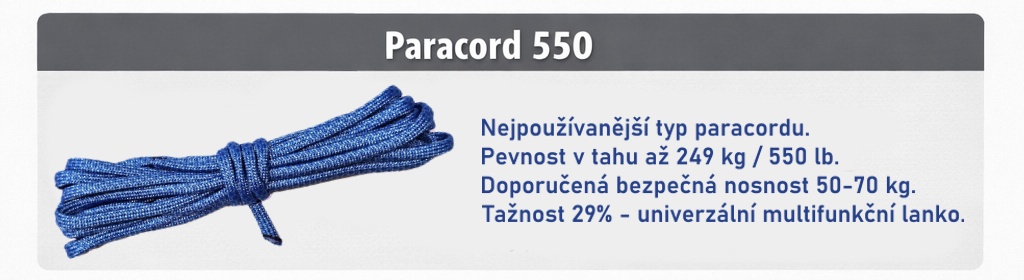
- Paracord 550 has a tensile strength of approximately 250 kg (550 lb).
- In destructive testing, high-quality Paracord 550 may often reach around 3000 N, equivalent to approximately 300 kg, before breaking.
- For normal, non-critical applications, we recommend allowing for an approximate load of 50–70 kg.
- Knots, abrasion, sharp edges, material ageing, sudden jerking or a weaker carabiner can significantly reduce the actual strength.
- In everyday life, paracord is ideal for DIY projects, dog leashes, collars, camping, survival, camp equipment and practical tying.
- Certified rope, not paracord, must be used for belaying people, abseiling or working at height.
For non-critical practical applications, it is reasonable to allow for an approximate load of around 50–70 kg, and only when the paracord is new, undamaged, free from sharp edges and not subjected to significant shock loading, while the finished product has suitable end connections and components.
Knots, a weaker carabiner, buckle or metal ring, abrasion, material ageing or sudden jerking will reduce the safety margin.
Load capacity, tensile strength and safe working load: why are these terms often confused?
In everyday language, people often ask: “What is the load capacity of paracord?” From a technical perspective, however, it is more accurate to distinguish between several terms. The specification most commonly given for paracord is its tensile strength, which is the value at which the cord breaks under laboratory conditions.
Safe working load is something different. This is the value that should be considered in real-world use, and it must always be significantly lower than the tensile strength itself. Practical use involves knots, friction, moisture, abrasion, material ageing, sunlight, sudden jerking and differences in the quality of the components used.
A simple rule therefore applies: the specification of 250 kg (550 lb) for Paracord 550 does not mean that it is suitable for routinely suspending 250 kg. It represents the technical breaking limit under ideal conditions.
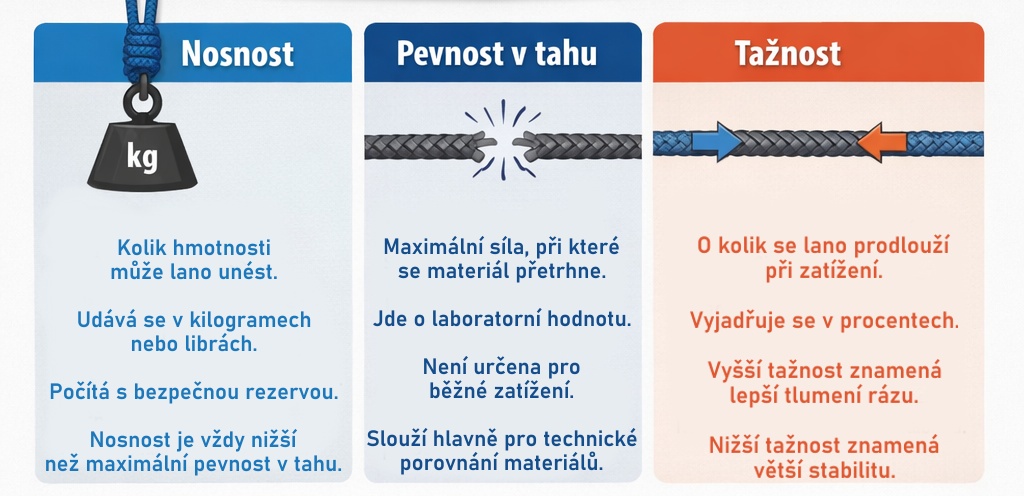
A few technical details for curious readers
- Tensile strength – the laboratory limit at which the cord breaks when pulled in a straight line. For Paracord 550, this value is approximately 250 kg (550 lb).
- Safe working load – a practical value for real-world use. It is only a fraction of the tensile strength because a safety margin must be maintained.
- Elongation – the amount by which the cord extends under load. Paracord can stretch under a heavy load, but it does not function as a dynamic rope for belaying people.
Note: In Czech, you may sometimes encounter the expression pevnost v trhu. This is an inaccurate colloquial term or a typographical error. The correct technical term is pevnost v tahu, meaning tensile strength.
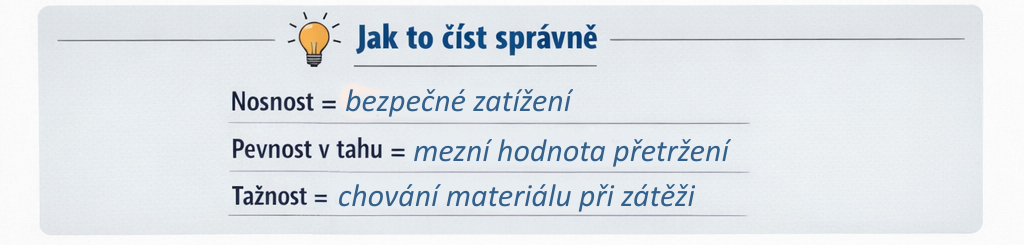
What this means in practice
When you use Paracord 550 to make a bracelet, keychain, braided handle, camp equipment or a utility cord for your backpack, its strength is more than sufficient. This is precisely why it is so popular for camping, survival, Scout craft activities, outdoor use and everyday household applications.
For products intended for dogs, such as dog leashes and collars, you need to consider not only the paracord itself, but also the carabiners, rings, buckles, end connections and braiding method. A finished product is always only as strong as its weakest point.
- DIY and outdoor use: Paracord 550 is an excellent all-purpose choice. It is easy to work with, available in many colours and suitable for beginners and experienced users alike.
- Dog leashes and collars: Paracord is a popular material, but for larger or powerful dogs, always consider the quality of the components and the braiding method.
- Camping and survival: It is suitable for tying down a tarp, repairing equipment, securing items together, suspending lighter equipment or making emergency accessories.
- Working at height and climbing: Paracord is not suitable for these applications. Always use certified static or dynamic ropes that comply with the relevant standards.
Climbers, arborists and outdoor enthusiasts may use paracord as a supplementary utility cord, for example to secure equipment, make minor repairs or simple loops, or handle lighter materials. However, it must never be confused with certified rope intended for belaying people.
Paracord 550 is not a climbing rope
Paracord 550 is not a dynamic climbing rope. It is not designed to arrest a fall, it is not tested to standards for belaying people and it does not have the properties of a rope intended for climbing, rescue work or working at height.
In an extreme emergency, people sometimes ask whether paracord could be used to climb down, lower themselves or perform a similar task. We do not recommend this as a planned method. Treat paracord as a versatile utility cord, not as safety equipment for situations involving a risk to health or life.
Usage and safety tips
- Remember that knots reduce strength. Always maintain a safety margin.
- Higher loads may not leave a sufficient safety margin, particularly when the cord is knotted, worn, abraded or subjected to shock loading.
- For dog leashes, collars and straps, inspect not only the cord, but also the carabiners, buckles, rings and end connections.
- For belaying people, fall-risk situations and working at height, use only certified ropes that comply with the applicable standards.
Overview of tensile strength by paracord type
For easier comparison, the table below provides an overview of the basic types of paracord and their approximate tensile strength. Treat these values as technical cord specifications, not as recommendations for belaying people or working at height.
| Cord type | Tensile strength | Main specifications | Where to buy |
|---|---|---|---|
| Paracord Micro 1,4 mm | approx. 29 kg | extra-thin paracord for fine details, decoration and combining with thicker cords | Paracord Micro |
| Paracord 100 Type I | up to 100 kg | approx. 2 mm, thin cord for finer bracelets, keychains and small projects | Paracord 100 |
| Paracord 425 Type II | approx. 181 kg | approx. 3 mm, an intermediate size between Paracord 100 and Paracord 550 | Paracord 425 |
| Paracord 550 Type III | approx. 250 kg (550 lb) | approx. 4 mm, 7 core strands, the most versatile classic for crafts and outdoor use | Paracord 550 |
| Glow cord | depends on the specific version | glow-in-the-dark cord that shines after exposure to light | Glow cord |
| Flame cord | min. 150 kg | approx. 4 mm, special flammable core for emergency fire starting | Flame cord |
| Paracord 750 Type IV | up to 340 kg | approx. 4,5 to 5 mm, thicker version for more heavy-duty applications | Paracord 750 |
| Paracord Max Type V | approx. 320 kg for the 6mm version | 6 mm, or 10 mm Max Ultra, thick cord for heavy-duty projects | Paracord Max |
For more detailed information about the differences between the various types, diameters and applications, read our article Differences Between Paracord Types.
Summary
Paracord 550 is a very strong and versatile cord. Its tensile strength is approximately 250 kg (550 lb). However, to maintain a safety margin for knots, wear, components and real-world conditions, it must be used with a significantly lower load in practice.
When you need a material for bracelets, dog leashes, collars, keychains, outdoor equipment, camping or craft projects, Paracord 550 is an excellent choice. However, for belaying people, fall-risk situations, working at height or lifting heavy loads, always use certified rope and equipment intended for the specific purpose.
Contact details and more information